The Cold Bench and the First Width: Rotherham’s Vanished Pools Remembered

Photo: vintage municipal swimming baths changing room wooden benches UK archive children towels, via www.babeyond.com
Ask anyone who grew up in Rotherham before the leisure-centre era about school swimming and watch their shoulders rise. The memory arrives before the words: cold tiles, wet wool, a towel rolled tight as a sausage, the sharp smell of chlorine that stayed in the hair until teatime. For generations of local families, the municipal baths were not simply somewhere to swim. They were public classrooms, Saturday rituals and, for many children, the first place they were asked to trust themselves in deep water.
At Rotherham Roots, our oral history recordings and archive photographs keep returning to these vanished pools. The buildings may have gone, or changed beyond recognition, but the stories have a remarkable hold. They are stories about shivering, certainly. They are also stories about confidence, water safety and the small social codes of a town at play.
The Walk to the Baths
In the recordings, the journey often comes first. Children in twos, a teacher at the front, a towel bag bumping against a leg. Some remember the walk through the streets as vividly as the pool itself: the cold air on wet hair afterwards, the chip shop on the corner, the feeling of being out of school but not quite free. The baths were a short trip that felt like an expedition.
Archive photographs show the queues outside municipal pools and the queues inside, too — for the cubicles, for the hair dryer, for the bus home. In an age of online booking and family changing rooms, it is easy to forget how public a public bath could be. You queued with neighbours. You shared a bench with strangers. You learnt, quickly, not to leave your towel on the floor.
Bench, Basket, Breath
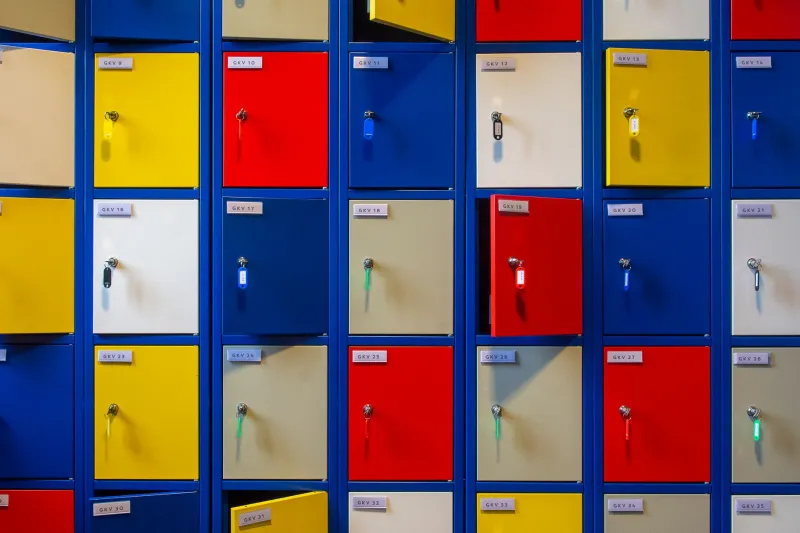
The changing rooms are where many memories begin to shiver. Cold wooden benches. Baskets or wire lockers. A damp smell that seemed to live in the walls. Children were told not to run, not to shout, not to forget their plimsolls. There was often a formidable attendant whose whistle could cut through steam.
And then the pool itself: a green-blue rectangle, echoing and bright, with a lifeguard on a tall chair and a pole that nobody wanted to see used. For non-swimmers, the first step down the steps was a negotiation with the body. The water was always colder than expected. The shiver before the splash was part of the lesson.
One oral history contributor remembers being told to ‘blow bubbles and keep breathing’, advice that sounds simple until you are chest-deep and convinced everyone is watching. Another recalls the relief of the shallow end and the quiet triumph of a first width without holding the rail. These are not just funny anecdotes. They are records of how children learnt to manage fear in public.
Widths, Lengths and Lifesaving
School swimming lessons in Rotherham, as elsewhere, were a practical business. There were widths and lengths, floats and bricks, certificates and badges. Pupils were taught to float on their backs, to call for help, to reach with a pole rather than jump in. The language of water safety was plain: stay calm, shout, reach, throw. Not every child became a strong swimmer. But many left with something more useful than style — a sense of what to do when water is not friendly.
That lesson still matters in 2026. Rotherham’s families live close to canals, rivers and reservoirs, and school programmes continue to stress water safety. What the old baths offer is a reminder that confidence is built in small, cold stages: standing in the shallow end, putting a face in the water, learning to breathe out slowly. The certificate was nice. The habit of courage was better.
The Social Pool
The baths were also a social map of the town. Saturday mornings brought families and toddlers; after school came lessons and galas; evenings belonged to clubs and lane swimmers. Pensioners swam through the week, and teenagers gathered at the deep end. In the pit villages and suburbs, the local pool could be a meeting place as much as a sports facility.
Oral histories often mention the lifeguards — not only for their whistles but for their watchfulness. They were the adults who noticed the child clinging to the side, the one who had gone quiet, the one who needed a word of encouragement. In a busy pool, that kind of attention was a form of community care.
What the Recordings Still Teach
The value of these memories is not nostalgia for cold water and queuing. It is evidence of how public spaces shape learning. The baths taught children to follow instructions, to share space, to ask for help and to try again after a mouthful of water. They gave families a place to gather and schools a place to take pupils beyond the classroom.
For today’s families and teachers, the old pools suggest a few simple questions. Where do children in Rotherham learn to be brave now? Which public spaces still bring different generations together? And what small rituals — the rolled towel, the locker token, the walk home with wet hair — are worth recording before they fade?
If you have a memory of Rotherham’s municipal baths, a school swimming lesson or a Saturday queue, Rotherham Roots would like to hear it. Oral history is not only for the famous. It is for anyone who can still remember the cold bench, the first width and the warm feeling afterwards.
Keep the Towel
The buildings may be gone, but the lessons have stuck to the town like chlorine to a swimming costume. They remind us that learning is often uncomfortable, social and slightly absurd — and that the shiver before the splash is sometimes the most important part.