Ribbons in the Rain: The Schoolyard May Days That Taught Rotherham to Hope
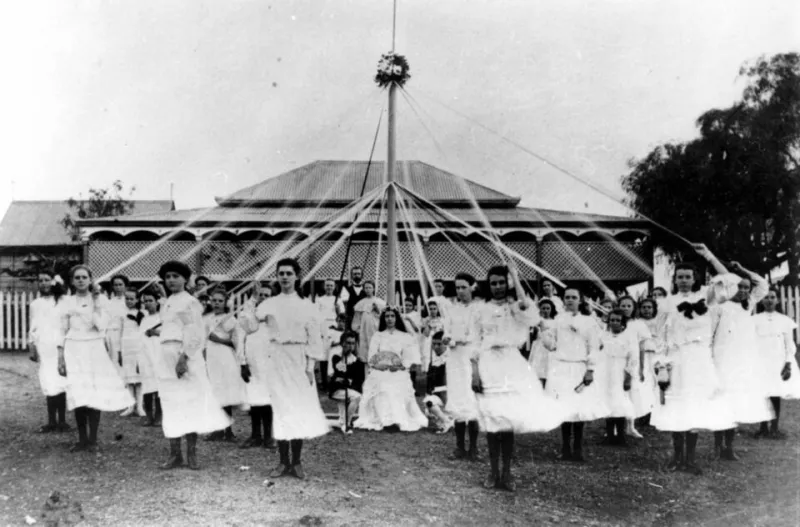
Photo: State Library of Queensland, Australia, No restrictions, via Wikimedia Commons
Ask anyone who grew up around Rotherham about the first week of May and you may get a story about a ribbon that would not stay put. Or a plimsoll lost in wet grass. Or the year the maypole leaned like a tired lamppost while a teacher pretended everything was going to plan. School May Days were never grand civic occasions, but they left their mark — a bright thread of spring running through ordinary school life.
The Week the Yard Turned Green
For many local families, May Day at school meant one thing: the yard stopped being just a yard. Overnight it became a stage. Chairs were carried out, a piano was wheeled to the door, and somebody was sent to find the box of ribbons that had been carefully put away the previous summer. In schools across the borough — from Eastwood and Kimberworth to Maltby, Wath and beyond — children rehearsed country dances, practised curtsies and learned that a maypole is a lot heavier than it looks.
The rituals varied. Some schools crowned a May Queen. Others settled for a few dances, a short assembly and the distribution of biscuits. Some years the whole thing happened on the field; other years it was hurried into the hall because the forecast had turned. The common ingredient was hope. Hope that the sun would hold. Hope that the ribbons would behave. Hope that the grown-ups watching from the edge of the playground would see something worth remembering.
What the Logbooks Left Out
School logbooks are rarely lyrical. They tend to record the practical business of education: attendance, staffing, weather, inspections and the occasional burst pipe. Yet even their brief entries can open a window. A line noting that May Day celebrations were held “weather permitting” tells us almost as much as a photograph. It suggests rehearsal, expectation and a plan B. It hints at teachers weighing up the clouds while children stood in lines, ribbons already in hand.
In oral history recordings, the details come back in warmer colours. People remember the feel of a paper crown, the smell of cut grass, the embarrassment of being paired with someone you secretly liked, and the fierce seriousness of getting a dance step right. They remember mothers and grandmothers on the edge of the yard, coats over their arms in case the weather changed. They remember that the maypole was not simply decoration; it was a test of coordination, patience and teamwork.
Daisies, Dew and the School Photograph
Then, as now, the school photograph froze only part of the story. A black-and-white image might show rows of children in summer dresses and shorts, ribbons streaming from a wooden pole. What it cannot show is the cold wind that made everyone shiver, or the teacher just out of frame mouthing instructions. It cannot show the child who forgot the steps, or the one who was quietly relieved when the rain finally arrived and everyone was sent inside.
Daisy chains were another essential feature of the season. For children in Rotherham, as elsewhere, May meant hunting for patches of daisies on the way to school and trying not to crush them before assembly. A daisy chain was a modest piece of jewellery, but it carried status. A long one, neatly joined, could be worn with pride. A short one was still better than none. These small acts of making and giving are part of what May Day taught: that celebrations can be homemade, and that a schoolyard can hold a whole community’s attention for an hour.
A Small Ceremony with a Long Reach
Why does any of this matter now? Because school rituals are not just entertainment. They are lessons in belonging. A maypole dance asks children to move together, to listen for a rhythm and to trust that the person opposite will do their bit. A daisy chain asks for patience and careful fingers. An outdoor assembly asks everyone to share the same weather, the same slightly uncertain wait, the same small cheer when the first ribbon finally wraps cleanly around the pole.
For families and schools looking at Rotherham’s heritage today, May Day memories offer a gentle way into local history. They connect the classroom to the seasons, and the school to the streets around it. They also remind us that not every important educational moment was written down in a formal record. Some of it survives only in the way someone’s face changes when they say, “Oh, I remember the maypole.”
How to Listen for May Day Now
If you have an older relative who grew up in Rotherham, this is a good season to ask a simple question: what happened at your school in May? You may hear about a maypole, a country dance, a crown made from crepe paper or a teacher who insisted on practising in the rain. You may hear about the year it snowed, or the year it was so warm the ribbons stuck to everyone’s hands. Those details are worth recording.
School photographs and logbooks held in local archives can help piece the picture together, but oral histories add the texture. They tell us how it felt to be eight years old with a ribbon in your hand and the whole yard watching. In 2026, as spring comes round again, Rotherham’s school May Days feel like a small but sturdy piece of our shared past — a reminder that hope, like a maypole, sometimes needs a few people to hold it steady while everyone else dances.