Sticky Ribbons and Singing Windows: Rotherham’s Christmas Fair Memories
Christmas in Rotherham has rarely been one big event. More often it has been a collection of small ones: a market stall wrapped in tinsel, a shop window painted at the last minute, a school hall filled with trestle tables and the smell of icing. Those details are easy to lose. They rarely make the official record. They live in family photographs, in newspaper adverts and in the memories of people who can still remember what a penny bought on a cold Saturday morning.
This festive oral-history feature is part of Rotherham Roots’ work with local archives and community learning. It is also an invitation. If you remember a Christmas market, a window display or a school-hall fair in the town or its villages, we would like to hear about it for our community archive.
Windows That Weren’t Just Windows
Before Advent calendars became the main countdown, many Rotherham families counted down through shop windows. Local newspaper adverts from the mid-twentieth century often promised ‘novelty displays’, ‘late opening’ and ‘gifts for all the family’. The wording was practical, but the effect was theatrical. A draper’s window could become a snowy scene. A grocer’s window might be stacked with tins and crackers. A toy shop could stop a child in their tracks on the walk from the bus station.
For families, the ritual was often a Saturday trip into town. You might queue for a bus, wrap up against the wind and promise yourself you were only looking. Then you would walk slowly past the windows, comparing them with last year’s. The best displays were not always the most expensive. A few cotton-wool snowdrifts, a string of coloured bulbs and a hand-painted sign could be enough to make the town feel different.
The Smell of the Stall
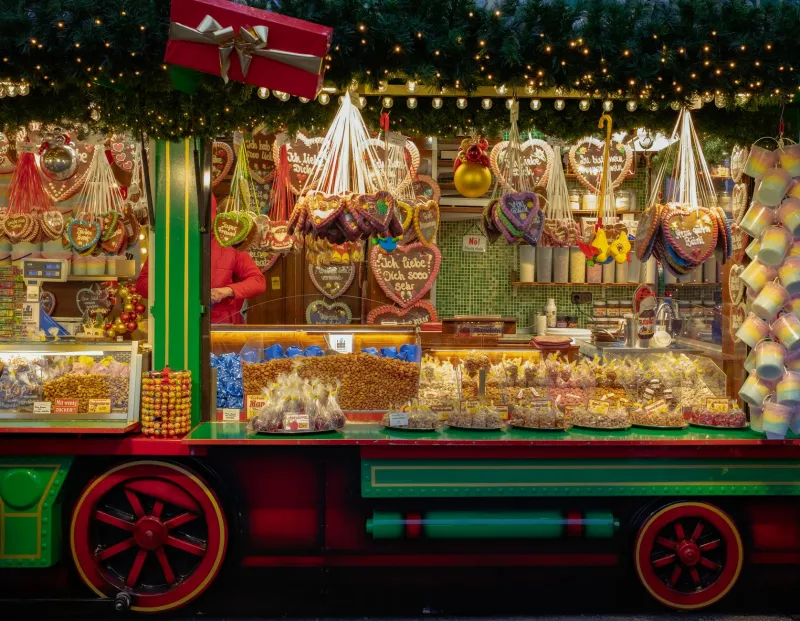
Ask anyone about Rotherham’s Christmas markets and the answers often begin with smell. Aniseed balls in paper bags. Brandy snaps. Hot chestnuts. Wet coats. The sharp, sweet fug of a stall selling sweets and toffee apples. Stallholders called out over the noise, and children worked out how far their pocket money would stretch.
Market memories are useful because they are sensory. A photograph can show the stalls, but it cannot always tell you that your gloves were damp, that your mother carried the shopping in a string bag, or that the queue for the bus home stretched around the corner. Those details are what make an oral history feel real. They also help later generations understand how the town worked: which streets were busiest, what people bought, how families travelled in and what a treat looked like.
Reminiscence prompt: What did Christmas shopping in Rotherham smell like? Was there a stall you always visited? Did you buy a present, or just look?
Sixpence in a Glove
School-hall fairs were another kind of Christmas market, held indoors and run on a shoestring. Lucky dips, bran tubs, hoopla, cake stalls, a grotto in the corner. Children saved pennies and sixpences, sometimes in a glove or a coat pocket, and spent them carefully. The hall smelled of floor polish, icing and the slightly damp coats piled on chairs.
Family photographs from these fairs often show the same things: trestle tables, handwritten signs, a teacher in a Christmas jumper, a queue of children waiting for their turn. They are ordinary pictures, but they are also maps of a community. The people behind the stall, the prizes on the table and the child in the front row can all open up stories.
Reminiscence prompt: Did your school hold a Christmas fair? What was the best stall? Were you allowed to help behind a table, or did you spend your money too quickly?
What the Adverts Leave Out
Newspaper adverts are a good starting point because they are dated, local and full of detail. They tell us when markets opened, which shops advertised Christmas goods and what things cost. But they cannot tell us everything. They leave out the weather, the waiting, the lost gloves and the family arguments about whether to buy the bigger box of chocolates.
That is why oral history matters. A memory can fill in the gaps between the printed lines. It can also correct the comfortable version. The Christmas market was not always a picture-postcard scene. It was crowded, cold and sometimes disappointing. That is part of the story too.
Add Your Voice to the Archive
Rotherham Roots is collecting Christmas market memories for a community archive. You do not need a polished story. A voice note, a scanned photograph with a few sentences, or a written memory is enough. Try to include the place, the rough date and the names of people you are happy to share. If you are recording someone else, ask their permission first.
You might start with one question: what do you remember first when you think of Christmas in Rotherham? The answer could be a window, a stall, a school hall or a bus ride home. All of them help keep the town’s festive past in view.
As we look towards Christmas 2026, the lights will be new and the shops may be different, but the habit is familiar. We still go out to look. We still meet people we know. We still come home with something small and sticky in a paper bag. The archive simply gives us a place to put it.