When the Bell Falls Silent: Rotherham's Closed Village Schools and the Paper They Left Behind
Photo: Frederick Bligh Bond, Public domain, via Wikimedia Commons
There is a particular kind of building in the villages around Rotherham that gives itself away. A porch with two doors. Windows set too high for a child to see out of. A bell bracket with no bell on it. A date stone over the entrance, usually somewhere between 1840 and 1900.
Most of these were village schools. Some are now halls, some workshops or stores, and a fair few are simply houses, with a kitchen where the classroom used to be and a row of coat hooks still screwed into the wall by the back door.
So what actually happens when a school closes? A building changes use, obviously. But the school itself — the register, the maps, the bell, the rhymes — has a stranger afterlife. Some of it lands in an archive. Some of it stays in a cupboard in the school down the road that inherited the children. And a good deal of it ends up in somebody's loft, which is why the asking matters.
The record that got kept by law
The most reliable survivor is the school logbook. Schools receiving a government grant were required to keep one from the 1860s onwards, and headteachers wrote in them with a frequency that modern readers find almost unbelievable — sometimes every single day.
They are not diaries, exactly. They are more like weather reports with children in them. Attendance, snow, fog, harvest. Children kept at home for potato lifting or haymaking. Measles going through the infants. A chimney that smoked. The vicar visiting. The day the inspector came and what he thought of the standard of recitation.
Then there are the admission registers, which are the family historian's best friend. Name, date of birth, address, parent or guardian, previous school, date of leaving — and often a brief reason, such as 'left for work' or 'removed to Wath'. A single register can sketch an entire household's decade in a dozen lines.
Beyond those, if you're lucky, you may find punishment books, stock and furniture inventories, managers' minutes, dinner registers, and occasionally a scrapbook of photographs kept by a teacher who couldn't bear to part with them.
The things nobody thought to throw away
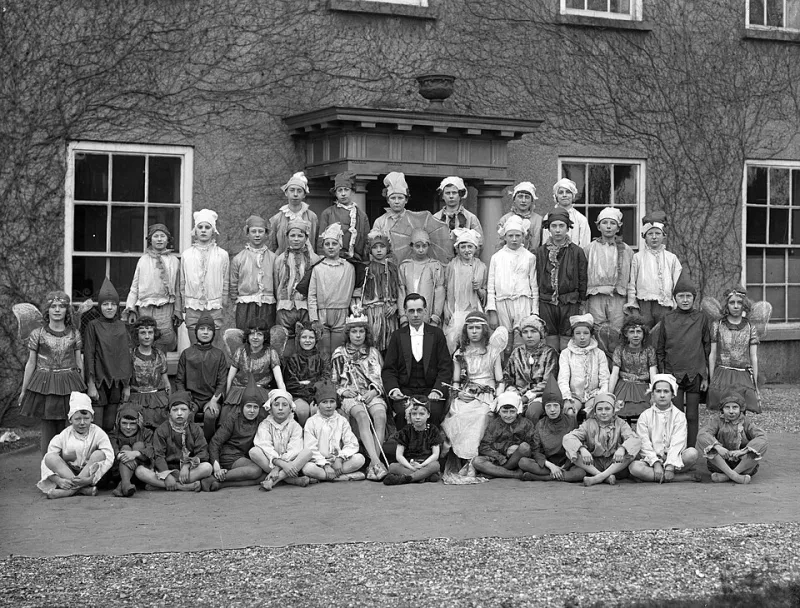
Paper is only half the story. Ask anyone who has cleared a closing school and they will tell you about the awkward objects. Wall maps on wooden rollers. A piano too heavy to move. A maypole. A framed photograph of a class from the 1920s with no names on the back. A bell that everyone wanted but nobody claimed.
These are the items that tell you how the room actually worked. A roller map pulled down over a blackboard tells you what children were shown. A row of numbered pegs tells you how order was kept.
The rhymes leave last — and leave fastest
The fragile record is the oral one. Clapping rhymes, skipping chants, the ritual humiliation of picking teams, the songs sung on the walk to the church at Christmas. Almost none of it was written down, and a school closing scatters the children who carried it.
This is the part that depends entirely on people. If your grandmother can still do the rhyme she learned in a village schoolyard outside Rotherham, that is an archive sitting in an armchair.
Tracing an ancestor through a closed school
A few practical starting points, in roughly the order worth trying:
- Work out which school served the address. Old Ordnance Survey maps, trade directories and the census returns will usually point you at the nearest school, even if the name has vanished from modern signage.
- Ask the successor school first. When small schools were absorbed, their registers often went with the children into the bigger primary up the road. A phone call costs nothing.
- Try Rotherham Archives and Local Studies, based at Clifton Park Museum, which holds a great deal of local school material alongside maps, photographs and newspapers.
- Check the local press. Closure notices, retirement tributes and nativity photographs were all printed, and they frequently include names the official records leave out.
- Know your dates. The 1870 Education Act created school boards, the 1902 Act reshaped secondary provision, the 1944 Act raised the leaving age to 15, and the reorganisation of the 1960s and 1970s turned many small all-age village schools into something else entirely. If a school disappears from the records, one of those dates probably explains why.
What to do with whatever you find
The worst outcome is a shoebox in a spare room. If you turn up a register, a photograph or an old punishment book, photograph it, name everyone you can identify on the back, and offer a copy to the local studies collection and to any school that still holds a connection. If a bell from a demolished school is hanging in someone's garden, tell that story somewhere.
A closed school is not the end of a record. It is a record that needs someone to keep asking after it.